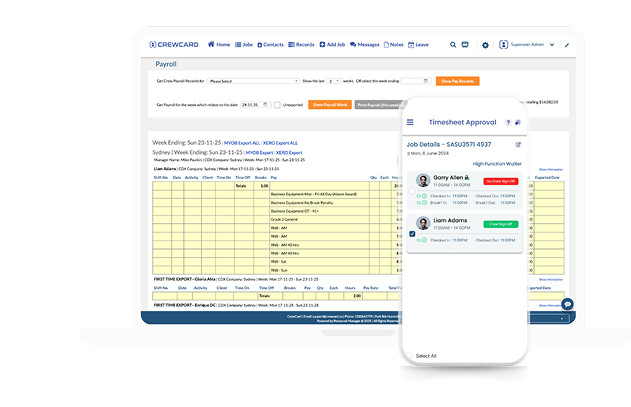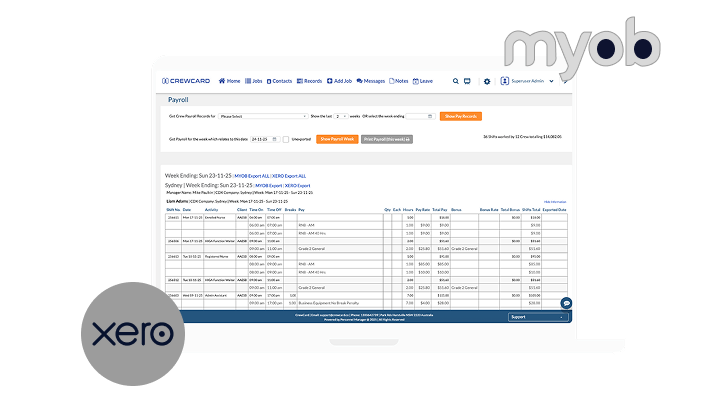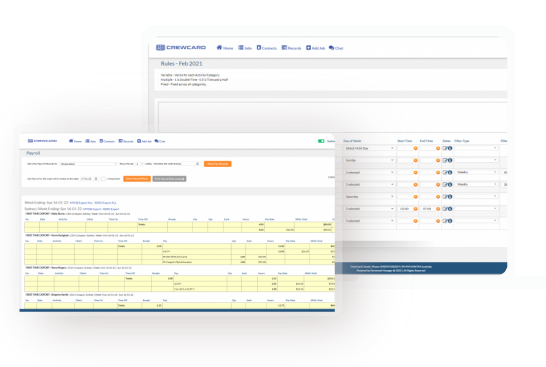
CrewCard’s financial module connects your workforce operations to accurate billing and payroll outcomes. Define pay and charge rates with precision, apply them to verified timesheets automatically, and generate professional invoices and payslips in minutes. Whether you’re managing casual crews, project-based teams, or full-time staff, the system adapts to your business rules—supporting overtime, allowances, billing tiers, and export-ready data for payroll partners. With CrewCard, you gain clear financial visibility, faster billing cycles, and confidence that your numbers are aligned with real-world workforce activity.

Ensure staff are paid accurately and consistently, minimizing costly corrections, disputes, and rework.

Gain better control over labor spend by applying consistent rules and reducing overpayments.

Cut payroll processing time by removing manual calculations and repetitive admin work.

Lower compliance risk by enforcing structured approvals and maintaining clear financial records.

Eliminate double handling by keeping time, pay, and billing connected across your systems.

Support business growth without increasing payroll complexity or administrative overhead.
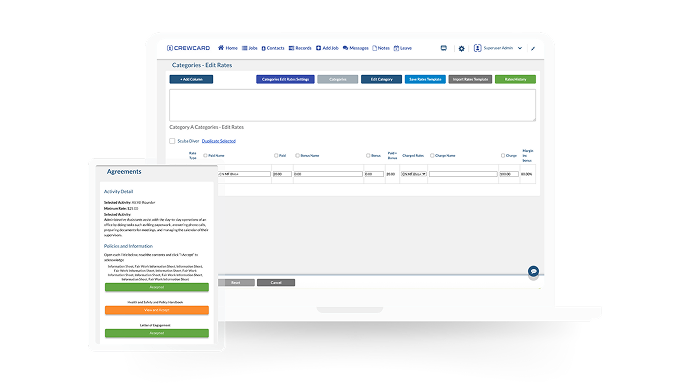
CrewCard allows businesses to build flexible pay structures that reflect how your workforce is actually paid. Create tiered pay rates based on role, experience, shift type, location, client agreements, or contract type. Add overtime rules, allowances, penalties, and custom pay conditions to ensure wages are applied consistently across your business. Once configured, these structures ensure every worker is paid correctly without relying on manual calculations or spreadsheets.
Once pay structures and rate tiers are configured, CrewCard automatically calculates wages using approved timesheets and your predefined pay rules. The system instantly applies base rates, overtime, allowances, and tiered rates, reducing human error and saving hours of manual payroll processing. This automation ensures consistent, accurate pay outcomes while dramatically reducing payroll rework and disputes.
Payroll is supported by structured approval chains that require validated timesheets before they are processed. Approved timesheets flow directly into payroll without manual exporting or re-entry. This strengthens internal controls, protects margins, and reduces financial risk.
CrewCard integrates with external accounting, payroll, and workforce platforms, allowing seamless data synchronization between systems. These integrations reduce manual data handling, prevent mismatched records, and support more efficient financial operations. Businesses can connect CrewCard into their existing tech stack to maintain continuity while improving speed, accuracy, and scalability of payroll workflows.
CrewCard allows businesses to build flexible pay structures that reflect how your workforce is actually paid. Create tiered pay rates based on role, experience, shift type, location, client agreements, or contract type. Add overtime rules, allowances, penalties, and custom pay conditions to ensure wages are applied consistently across your business. Once configured, these structures ensure every worker is paid correctly without relying on manual calculations or spreadsheets.
Yes — CrewCard can handle retroactive pay adjustments, through its built‑in payroll amendment functionality.
yes — you can put in place controls to help prevent unauthorised pay charges, assuming you enforce good user‑access discipline (e.g. limit who has Payroll‑Portal access, require two‑step auth, log changes, etc.).
Yes — CrewCard can manage large‑volume payroll runs efficiently. It’s built to handle many staff with varied rosters in a single pay run.
You can manage payroll across multiple entities or divisions — though exact setup (e.g. whether separate divisions count as separate “business” entities in CrewCard) may require configuration.
Yes — CrewCard maintains a robust audit trail: time records, approvals, edits, pay runs and exports are all tracked and retrievable, which supports transparency, compliance, and auditing.