
Why Timesheet Approvals Delay Payroll in Staffing Agencies (and How to Fix It)
Payroll is approaching, but several timesheets are still waiting for supervisor or client approval. Operations is chasing signatures, payroll is waiting for confirmed hours and the deadline is getting closer.
Timesheet approval delays can leave staffing agencies with a last-minute choice between investigating records and completing payroll on time. This guide explains why approvals get stuck and gives you a practical process to fix the bottleneck before the next pay run.
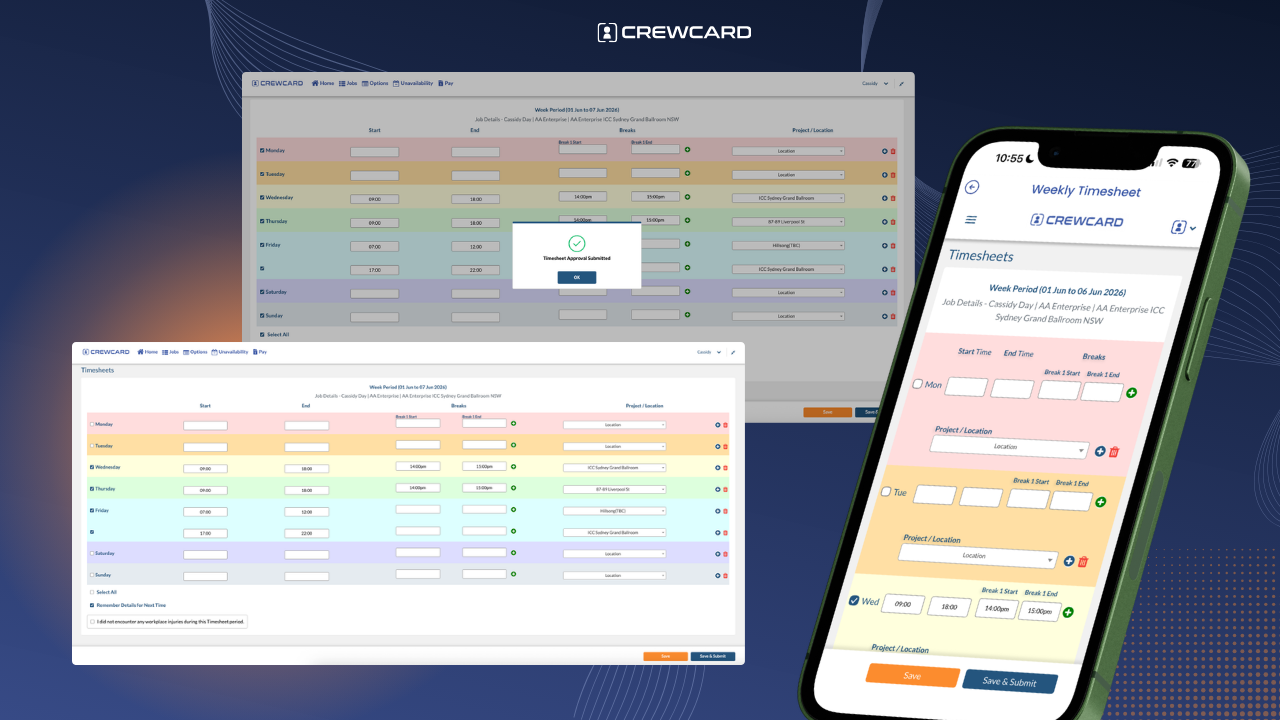
CrewCard Weekly Timesheets: Keep worked hours, breaks and approval information connected before payroll preparation begins.
Timesheet approval delays happen when worked hours cannot be verified or signed off before payroll preparation begins. Fix the bottleneck by assigning approval owners, setting deadlines before payroll cutoff, reviewing exceptions early and escalating missing responses to a designated backup. Payroll should have a documented process for paying all compensable hours on time, even when client sign-off is still pending.
Why Timesheet Approval Delays Happen in Staffing Agencies
A staffing agency may have hundreds of employees working across different client sites, supervisors and shifts. Each completed shift creates a record that needs to be checked before it reaches payroll preparation.
The problem often isn't the number of timesheets. It is the number of people and disconnected steps involved in getting them approved.
Missing Approvals
Client or site supervisors have not reviewed completed hours by the deadline.
Unclear Ownership
Operations and payroll are unsure who should resolve pending records.
Late Escalation
Problems are discovered only when payroll is about to close.
Other common causes include missing check-outs, unrecorded breaks, disputed hours, incorrect job assignments and supervisors who approve timesheets only once a week.
When nobody owns the next action, a timesheet can sit in Pending status even when the underlying hours are straightforward to verify.
How Pending Timesheet Approvals Affect Payroll and Client Billing
Timesheet approvals connect operational records to two important financial processes: employee payroll and client invoicing.
When approval is late, payroll administrators may need to investigate hours manually, contact supervisors or reconcile conflicting records against the schedule.
Delayed approval can also create uncertainty around client billable hours, particularly when a client disputes a worker's start or finish time.
Payroll Rework
Payroll staff spend time chasing confirmations and checking amended hours.
Worker Questions
Employees may query their hours or pay when records are unresolved.
Billing Delays
Client invoice preparation can slow when billable hours remain disputed.
The solution is to move approval decisions closer to the completed shift instead of waiting for payroll staff to resolve every issue at the end of the week.
Timesheet Errors vs Timesheet Approval Delays
These two problems are related, but they require different solutions.
| Problem | What Is Wrong? | Best First Action |
|---|---|---|
| Timesheet error | The time record contains missing or inaccurate information. | Investigate and correct the worked-time record. |
| Approval delay | The timesheet is complete but the required reviewer has not acted. | Remind or escalate to the responsible approver. |
| Disputed timesheet | The worker and client report different hours. | Compare available evidence and document the resolution. |
| Payroll cutoff risk | The pay deadline is approaching with unresolved records. | Escalate immediately and apply the employer's lawful pay-resolution process. |
For the separate issue of inaccurate timesheet information, see our existing guide: How to Reduce Timesheet Errors Before Payroll .
A 48-Hour Timesheet Approval Plan Before Payroll Cutoff
The most useful way to reduce timesheet approval delays is to set review deadlines before payroll processing begins.
The following is an example internal workflow for a staffing agency. Adjust the timing to match your pay schedule, shift patterns and legal obligations.
48 Hours Before Cutoff
Review all completed shifts with pending timesheets. Identify missing submissions, approval owners and unresolved exceptions.
24 Hours Before Cutoff
Send targeted reminders to supervisors and clients. Escalate overdue responses to the designated operations manager.
12 Hours Before Cutoff
Resolve remaining exceptions using available attendance, job and worker records. Flag unresolved cases for payroll review.
At Payroll Preparation
Reconcile payroll hours, review exceptions and keep client billing disputes separate from statutory pay obligations.
An employer's obligation to pay for compensable hours worked does not disappear because a supervisor or client has not approved a timesheet. Do not use this example workflow to postpone wages beyond applicable payment requirements.
Who Should Approve Timesheets Before Payroll?
Approval problems become easier to resolve when every stage has a defined owner.
Staffing agencies can assign different responsibilities to employees, onsite supervisors, operations managers and payroll. The exact process depends on how the agency works with clients.
| Role | Responsibility | Escalation |
|---|---|---|
| Worker | Record actual work hours, breaks and relevant shift information. | Contact operations if unable to submit. |
| Site Supervisor | Review hours against the work performed and approve or flag discrepancies. | Refer unresolved differences to the agency. |
| Operations Manager | Monitor pending approvals and coordinate exception resolution. | Take ownership before the payroll deadline. |
| Payroll Team | Reconcile compensable hours, rates and required pay records before processing. | Escalate unresolved wage questions through the appropriate payroll process. |
When a client supervisor has not responded, the agency should have an authorized internal process for reviewing available evidence rather than leaving a record without an owner.
Which Pending Timesheets Should Be Reviewed First?
Not every pending record presents the same risk. A useful approval process separates simple pending signatures from records that actually need investigation.
Payroll cutoff: Prioritize records affecting the next scheduled pay run.
Missing worked hours: Investigate shifts without complete time information.
Overtime: Review unexpected additional hours that may affect wage calculations.
Client disputes: Identify conflicting accounts of attendance or worked time.
Late approvals: Escalate completed records waiting only for a reviewer.
A simple pending-approval dashboard helps teams see which records require action instead of searching through every completed shift.
Timesheet Approval Reminder and Escalation Templates
Clear messages can help resolve timesheet approval delays before payroll cutoff. Include the shift details, exact deadline and required action.
Template 1: Supervisor approval reminder
Hi [Supervisor Name], the timesheet for [Worker Name] at [Client / Site] on [Shift Date] is awaiting review. Could you please approve the recorded hours or flag any discrepancies by [Deadline]? Thank you.
Template 2: Operations escalation
The following timesheet remains pending ahead of payroll cutoff: [Worker / Job / Shift]. The original reviewer has not responded by [Deadline]. Please review the available attendance records and confirm the next action with payroll.
Template 3: Client discrepancy request
Hi [Client Name], we're reviewing the [Date] timesheet for [Worker / Role]. The submitted hours differ from the expected shift time. Could you please confirm the actual start, finish and break details by [Time]? This will help us finalize the record accurately.
Keep any personal worker information limited to what the recipient is authorized to see.
Can Payroll Be Delayed Because a Timesheet Has Not Been Approved?
An internal approval workflow does not override wage and hour requirements. Employers must accurately record and pay for compensable work under applicable law.
The U.S. Department of Labor explains that covered employers must keep accurate records of hours worked and wages earned. See its official FLSA Recordkeeping Requirements .
The Department also explains that employers must pay for work they know or have reason to believe was performed, even when it was not requested or authorized. See its Hours Worked guidance .
A delayed client approval may affect when the agency finalizes an invoice, but it does not automatically justify withholding employee wages. Applicable payday, overtime and state or local rules must also be considered.
A client billing dispute and an employee's entitlement to pay are different issues. Your payroll process needs a lawful method for resolving missing or disputed hours without simply waiting for the client's signature.
How to Prevent Timesheet Approval Delays Next Pay Period
Fixing this week's backlog is helpful. Preventing the same backlog next week is more valuable.
1. Review timesheets closer to shift completion
Ask supervisors to review completed shifts while the details are still fresh. This reduces the number of questions left until payroll.
2. Create approval deadlines
Set internal review cutoffs before the payroll processing deadline and communicate them to all approvers.
3. Assign a backup approver
Identify who can review timesheets when the usual supervisor is absent or unavailable, subject to the agency's authorization rules.
4. Review exceptions separately
Do not make straightforward timesheets wait behind complicated investigations. Separate records needing clarification from those ready for approval.
5. Monitor pending approval trends
Review which clients, locations and supervisors generate the most overdue timesheets. Focus improvement efforts on recurring bottlenecks.
6. Connect scheduling with actual worked time
Keeping scheduled and actual hours together makes it easier to investigate discrepancies without rebuilding information from emails and spreadsheets.
Pre-Payroll Timesheet Approval Checklist
Use this checklist before every payroll processing deadline to identify outstanding approval risks.
All completed shifts have a corresponding worked-time record.
Pending timesheets have an assigned approval owner.
Missing start, finish and break details have been investigated.
Unexpected overtime and other pay-affecting exceptions have been reviewed.
Overdue supervisor approvals have been reminded or escalated.
Disputed hours have supporting evidence and a documented resolution process.
Payroll has reviewed compensable hours, including unresolved approval cases.
Pay obligations and applicable deadlines have been addressed independently of client billing.
Client billing disputes are tracked separately for follow-up.
The final approved and reconciled records are ready for the payroll workflow.
How CrewCard Helps Reduce Timesheet Approval Delays
When shift scheduling, attendance records and timesheet approvals are managed in separate systems, payroll teams may have to reconcile the same information repeatedly.
CrewCard connects scheduled shifts, GPS-backed check-ins, recorded breaks, submitted timesheets and supervisor approvals within one workforce workflow.
Review Pending Hours
Keep submitted and pending timesheets visible for review.
Approve Worked Time
Give appropriate supervisors a way to review and approve shift records.
Prepare Payroll Data
Keep approved hours connected to the next stage of payroll preparation.
For staffing agencies, this can reduce the need to repeatedly chase information across separate messages and spreadsheets.
Explore Employee Time Tracking Software , Payroll Automation Software and Employee Scheduling Software to see how the connected workflows support each other.
CrewCard supports recordkeeping and approval workflows. Employers remain responsible for ensuring accurate wages, lawful payment timing and appropriate approval decisions.
Key Takeaway: Move Approvals Earlier, Not Payroll Later
The best way to reduce timesheet approval delays is to stop treating approval as a task that begins on payroll day.
Capture worked hours → Assign an approver → Review exceptions → Escalate pending records → Reconcile payroll.
Keep client billing questions separate from employee wage obligations and make sure every pending record has a responsible owner.
Frequently Asked Questions
Why do timesheet approvals delay payroll?
Timesheet approval delays occur when supervisors or managers have not reviewed submitted hours, when discrepancies remain unresolved or when the agency lacks a clear escalation process.
How can staffing agencies speed up timesheet approval?
Assign approval owners, set deadlines before payroll cutoff, review records soon after shifts end and escalate overdue timesheets to an authorized backup.
Can an employer withhold wages because a client has not approved a timesheet?
Client approval does not automatically remove the employer's wage obligations. Employers must comply with applicable federal, state and local rules for compensable hours and payment timing.
When should timesheets be approved?
Ideally, timesheets should be reviewed soon after the shift ends and before payroll preparation begins. Internal deadlines must allow enough time for escalation and lawful wage processing.
What if a supervisor does not approve a timesheet?
Contact the supervisor, set an escalation deadline and refer the record to an authorized manager or payroll reviewer. Use available time records to investigate hours worked.
Can timesheet software help prevent approval delays?
Yes. Timesheet software can provide visibility into submitted hours, approval statuses and related shift records. The agency still needs a defined approval and escalation process.
Final Thoughts
Timesheet approval delays are often a coordination problem rather than simply a payroll software problem.
When approvers, managers and payroll staff know what they are responsible for, pending records are easier to resolve before the deadline.
Start with a clear approval owner, an early review deadline and a documented escalation process. These changes can make payroll preparation more predictable for staffing agencies.
Stop Chasing Timesheet Approvals at Payroll Cutoff
Keep completed shifts, worked hours, supervisor reviews and payroll preparation connected. See how CrewCard can help your operations and payroll teams manage approvals more clearly.